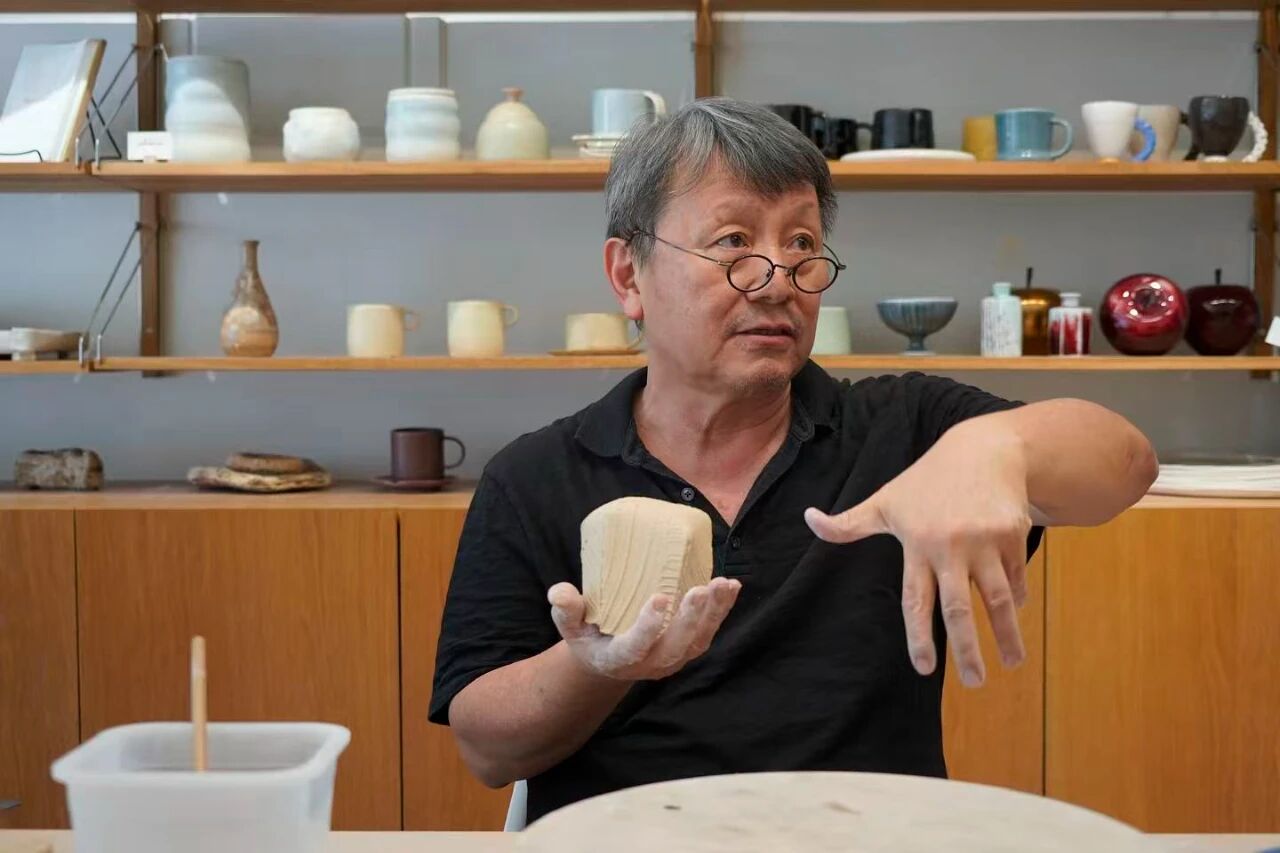
张清渊陶瓷艺术家中国台湾台南艺术大学教授、应用艺术研究所所长
采访手记:
在张清渊的话语中,始终贯穿着对文化根脉的追问、对教育本质的思考,以及对年轻一代的期待。在他看来,陶瓷不仅是手艺,更是文明与时代的映照;双年展不是终点,而是对话与反思的起点。在景德镇这片古老又崭新的土壤上,一场关于陶瓷未来的对话,正在悄然生长。
Q:于伶娜
A:张清渊
Q:在你看来,面对亚洲当代陶艺的核心困境——话语权缺失的背景下,景德镇国际陶瓷艺术双年展是如何发挥其破局作用的?
A:其叙事体系从上个世纪50年代起就由西方主导,中日韩虽有悠久陶瓷历史,却长期陷入“先西化再回归”的路径——日本1945年后受毕加索等西方艺术家影响,先突破传统再寻本土表达;韩国也是先接轨西方,再探索自身特色。
中国其实有形成独特语境的可能,毕竟中国当代艺术已在国际上有重要影响,陶艺只是“慢一步”。而景德镇双年展正是破局的关键:它可以像“文化疫苗”一样,让我们开放接纳西方理念,激发自身抗体,逐步建立自己的话语体系,走出一条既非日韩、也非西方的独特路径。但目前仍需打破“士大夫观念”,扭转“画画是大师、拉坯烧窑是工匠”的认知,让工艺环节的艺术性被看见,这是陶艺突破的关键前提。
Q:你曾参与多个国际陶艺双年展,如果要直观概括日本美浓、韩国利川、中国景德镇三大陶艺双年展的现状,你会怎样表述?
A:日本像一棵树,曾经水分充足,如今新苗生长乏力;韩国也是一棵树,不大不小,水分够用但不算充沛,新苗长得普通;景德镇则是一棵根深叶茂的古树,新苗争相萌发,充满竞争与活力。
Q:站在亚洲视角,景德镇双年展的核心优势是什么?
A:日本美浓、韩国利川都曾借助经济优势推动双年展,但也逐渐面临经费和评审本土化的争议。景德镇的核心优势是不可替代的深厚的陶瓷文化底蕴,这是双年展的“基石”。
十几年来,景德镇聚集了全世界的陶瓷爱好者,形成了“万物可试、作品多元”的创作生态。同时,双年展评委阵容涵盖全球顶尖陶艺学者与艺术家,评审过程相对公正,结果争议远少于其它同类赛事,已成为全球陶艺界认可的核心平台,吸引了全球陶艺创作者的热情参与。
Q:双年展已成功举办两届,你也多次往返陶大和国美进行学术交流,你对两届双年展的整体观感如何?
A:景德镇这十多年吸引了全世界对陶瓷感兴趣的人,它像一个能量高度聚集的地方,什么都有可能发生。我看到很多年轻人通过网络学习国外作品,这是好事,学大师的手法和眼光是必要的。但关键是要“看进去”——不仅要看见形式与美感,更要理解作品背后的时空背景与人文思维。现在不少年轻人的技术令人赞叹,但作品常让人觉得“似曾相识”。好在也有一些年轻创作者,技术扎实且有独立创作内核,不再是“有技术无思想”的空心状态,开始走出自己的路。
Q:你鼓励在校学生用成熟作品参赛,而不是为了比赛去创作,这一教育理念的底层逻辑是什么?
A:在校阶段是创作者找“自我创作意义”的关键期,为比赛定制作品容易偏离创作初心,不要为比赛创作,而是让创作本身成为常态,用成熟的作品参与交流,避免陷入“为获奖而创作”的功利陷阱。创作应该源于自己对材料、文化、生活的持续探索与回应。有了成熟的作品,再去参赛,这样心态更稳,路径也更长远。
毕业生已完成创作认知的积累,国际赛事是他们展露头角、对接更广阔行业资源的最优路径,能为职业发展奠定基础。
Q:对景德镇双年展的未来发展,你有哪些具体建议?
A:除了竞赛,还可以强化策展与观念引导。通过策展人的主题策划,聚焦当代陶艺的重要现象与思潮,让观众——尤其是年轻创作者——不仅看到“好作品”,更理解背后的观念与动机。这比单纯展示作品更有教育意义。从事传统陶瓷工艺的群体,需要提升对当代生活与美学的感知。他们的技艺无可取代,但作品的气质需要匹配21世纪人文语境,而非停留在明清时期的审美逻辑里。
Q:陶瓷艺术的边界正在被打破,你认为未来十年最值得期待的突破点是什么?
A:边界拓展的核心是“开放”。青花画在身体上、泥土不烧制、行为与影像……这些都已进入陶瓷艺术的表达范畴。未来十年,我最期待的是科技与陶瓷的对话。年轻一代在科技环境中成长,他们如何用陶瓷回应人工智能、虚拟现实等议题,将是一个重要的突破点。
至于AI创作,只要作品能打动人心、拓展认知,我不排斥它出现在陶艺展中,就像杜尚的现成品,重要的是观念与选择。但要注意,科技是工具,不能替代手工的价值——手与材料的沟通过程,是陶艺不可替代的核心价值,这一点不能丢。
Q:最后,请对青年陶艺家说一段话,关于如何保持勇气和创新。
A:很简单,也最难:继续做。不要为了比赛而创作,要为了表达而创作。创作的勇气与创新,都藏在日复一日的坚持里,只有先完成持续的创作积累,才有可能实现真正的突破。坚持创作,保持质疑,持续检视——这才是艺术家该走的路。
英文版
Exclusive Interview | Ceramic Artist Zhang Qingyuan:CJICB, the starting point of dialogue and reflection
Zhang QingyuanCeramic artistProfessor and Director of the Graduate Institute of Applied Arts, Tainan National University of the Arts, Taiwan, China
Interview Notes:
In Zhang Qingyuan’s words, there is a constant thread of questioning cultural roots, reflecting on the essence of education, and expressing expectations for the younger generation. For him, ceramics is not just craftsmanship—it is a mirror of civilization and its era. The Biennale is not an endpoint; it is a starting point for dialogue and reflection. In Jingdezhen—this land both ancient and renewed—a quiet conversation about the future of ceramics is already taking shape.
Q = Yu Lingna
A = Zhang Qingyuan
Q:In your view, under the core challenge of contemporary Asian ceramics—the lack of discourse power—how does the Jingdezhen International Ceramic Art Biennale act as a game-changer?
A:Since the 1950s, the narrative system has been dominated by the West. Although China, Japan, and Korea all have long ceramic histories, they have long fallen into the path of “Westernization first, then returning to tradition.”After 1945, Japan was influenced by Western artists such as Picasso—breaking from tradition before seeking local expression. Korea took a similar path: aligning with the West first, then exploring its own identity.China actually has the potential to form a unique discourse, since Chinese contemporary art already has significant international influence—ceramics is simply “one step slower.” The Jingdezhen Biennale is a key breakthrough: like a “cultural vaccine,” it allows us to openly absorb Western ideas, stimulating our own “antibodies” and gradually building our own narrative system—one that is neither Japanese/Korean nor Western, but uniquely ours.But we still need to break the old “scholar–artisan hierarchy,” overturning the mindset that “painters are masters while potters are craftsmen,” and allowing the artistic value of craftsmanship to be seen. This is a crucial prerequisite for ceramics to truly break through.
Q:You have participated in many international ceramic biennales. If you were to summarize the current status of the three major biennales—Mino in Japan, Icheon in Korea, and Jingdezhen in China—what would you say?
A:Japan is like a tree that once had abundant water, but whose new shoots now struggle to grow. Korea is also a tree—average in size—with adequate but not abundant water, producing ordinary new shoots.Jingdezhen, however, is an ancient tree with deep roots and flourishing leaves, with new shoots sprouting everywhere—full of competition and vitality.
Q:From an Asian perspective, what is the core advantage of the Jingdezhen Biennale?
A:Both Mino and Icheon once relied on economic advantages to propel their biennales, but they now face funding difficulties and controversies over local competitions and judging.Jingdezhen’s core advantage lies in its irreplaceable cultural depth—this is the “bedrock” of the Biennale.Over the past decade, Jingdezhen has attracted ceramic lovers from all over the world, forming a creative ecosystem of “limitless experimentation and diverse works.” Meanwhile, the Biennale’s jury brings together leading scholars and artists from around the world; its judging is relatively fair and far less disputed than many other competitions. It has become a central platform recognized by the global ceramics community, drawing enthusiastic participation from ceramic artists worldwide.
Q:The Biennale has already hosted two successful editions. Having traveled frequently between Jingdezhen Ceramic University and the China Academy of Art, what are your overall impressions of the two editions?
A:Over the last decade, Jingdezhen has attracted people from all over the world who love ceramics—it is a place where energy gathers intensely and where anything seems possible.I see many young people learning from international works online; this is good—learning the techniques and vision of masters is essential. But the key is to “look deeper”—not only at forms and beauty, but at the historical, spatial, and cultural thinking behind the works.Many young creators today have impressive technical skills, yet their works often feel “familiar.” Fortunately, some young artists already have both solid technique and a strong individual core—they are no longer “technically skilled but conceptually hollow,” and are beginning to carve out their own paths.
Q:You encourage students to use mature works for competitions rather than creating specifically for competitions. What is the underlying logic of this educational approach?
A:School is the crucial period for creators to discover the “meaning of their own creation.”
Works created solely for competitions often deviate from true creative intention. Do not create for competitions—let creation be a natural, ongoing process. Use mature works for competition and exchange, avoiding the trap of “creating for the sake of awards.”
Creation should arise from continuous exploration and response to materials, culture, and life. With mature works, you enter competitions with a steadier mindset and a longer, more sustainable path.
Graduates have already built up a foundation of creative understanding; international competitions are the best way for them to gain visibility and connect with broader industry resources, laying groundwork for professional development.
Q:What suggestions do you have for the future development of the Jingdezhen Biennale?
A:Beyond competitions, curation and conceptual guidance should be strengthened.
Through curatorial themes, we can focus on important phenomena and trends in contemporary ceramics, helping audiences—especially young creators—not only appreciate “good works,” but understand the ideas and motivations behind them. This is more educationally meaningful than simply showing artworks.
Traditional ceramic artisans need to improve their sensitivity to contemporary life and aesthetics. Their techniques are irreplaceable, but thespirit of their works must resonate with 21st-century cultural contexts, rather than remain within the aesthetic logic of the Ming–Qing dynasties.
Q:As the boundaries of ceramic art continue to expand, what breakthroughs do you expect in the next decade?
A:The core of expanding boundaries is openness. Blue-and-white painting on the body, unfired clay, performance, video—these have all already entered the expressive realm of ceramic art.
In the next ten years, I most look forward to the dialogue between technology and ceramics. The younger generation grew up with technology—how they use ceramics to respond to issues such as artificial intelligence and virtual reality will be a significant breakthrough.
As for AI-created works, as long as they move people and expand understanding, I do not object to their presence in ceramic exhibitions—just like Duchamp’s readymades. What matters is the concept and the choice.
But remember: technology is a tool. It cannot replace the value of handcraft. The communication between the hand and the material is the irreplaceable core of ceramic art—this must never be lost.
Q:Lastly, what would you say to young ceramic artists about maintaining courage and innovation?
A:It is simple, yet the most difficult: keep doing it.
Do not create for competitions; create for expression.
Courage and innovation come from persistence—day after day. Only through continuous creative practice can true breakthroughs occur.
Keep creating. Keep questioning. Keep examining yourself.
This is the path an artist must walk.
(责任编辑:刘欢 审稿:兰茜 刘欢)