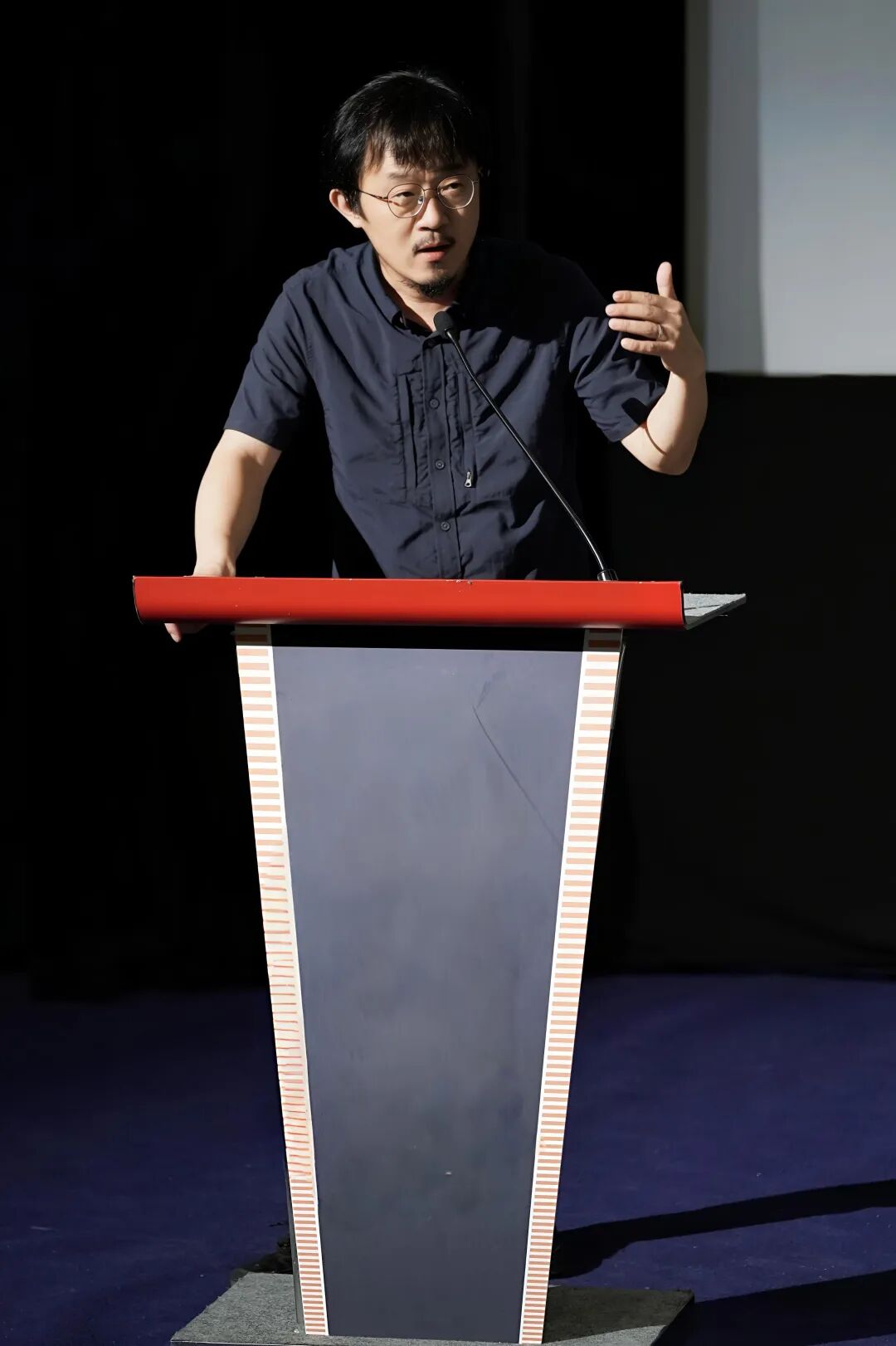
Liu Libin
Professor, PhD Supervisor, and Head of the Department of Arts Management, School of Arts Management and Education, Central Academy of Fine Arts
Distinguished “Jinggang Scholar” Appointed Professor by the Jiangxi Provincial Government (Jingdezhen Ceramic University)
Interview Notes:
Against the backdrop of China’s comprehensive economic and cultural rise, the Jingdezhen International Ceramic Art Biennale has adopted a distinctive stance, actively examining and evaluating global ceramic art phenomena. Through discursive practice, it is reshaping the global framework of dialogue in ceramic art.
This construction of “subjectivity,” grounded in a millennium-old tradition and a contemporary creative ecosystem, has positioned the Biennale as an intellectual arena that combines academic vision with cultural mission. Looking ahead, Liu Libin outlines a clear path: breaking free from the self-imposed boundaries of the ceramic field and situating creation within broader contemporary art questions; while also actively embracing the technological revolution, allowing new artistic languages that combine the spirit of craftsmanship with the character of the times to emerge from the deep integration of art and technology.
As the 2026 Biennale aligns with the IAC Congress in a dual-track collaboration, a dynamic arena of deep interaction between exhibition and forum is about to take shape—potentially marking a historic turning point in which Chinese ceramic art moves from “subject construction” toward “agenda-setting.”
Q:Yu Lingna
A:Liu Libin
Q:“Locality” and “internationality” are two key terms in current cultural discussions. From these perspectives, how does the Jingdezhen Ceramic Art Biennale fundamentally differ from established ceramic exhibitions such as Faenza in Italy, Mino in Japan, and Icheon in Korea?
A:The core context behind these differences lies in China’s upward economic, political, and cultural development. This allows us to draw upon our millennia-old ceramic tradition and contemporary advances—including ongoing developments in ceramic art and craft ceramics—to reassess global ceramic art within a new international framework.
Although traditional international biennales are international in scope, Chinese ceramic exhibitions in the past were often overly localized. Even when international artists were invited, their participation was largely symbolic, lacking a comprehensive, self-positioned understanding and visual presentation of global ceramic art.
Today, the locality of the Jingdezhen Biennale has evolved into a national, and even “Eastern,” perspective. We now have the capacity to form distinctive viewpoints on global ceramic art based on our own history, traditions, and contemporary practices. This constitutes the most fundamental difference from established biennales.
Q:In addition to international biennales, many ceramic biennales have emerged in China in recent years. What do you see as the core competitiveness or defining feature of the Jingdezhen Ceramic Art Biennale?
A:Its core competitiveness lies in Jingdezhen’s unique ecosystem. It possesses an irreplaceable traditional foundation—as a millennium-old porcelain capital, its accumulated ceramic memory, material mastery, cultural narratives, and artistic positioning are unmatched globally.
It also demonstrates vibrant contemporary transformation. In recent years, new ceramic art phenomena have emerged continuously, with traditional craftsmanship and contemporary concepts intersecting and innovating. Moreover, it has a powerful market and creative ecosystem, bringing together diverse elements of ceramic production nationwide. The interaction among migrant artists (“Jing drifters”), Taoxichuan studios, exhibition spaces, and museums has formed an art phenomenon with nationwide influence—an ecosystem of rare global uniqueness.
More importantly, it maintains academic independence. Unlike local biennales focused on single categories such as celadon or blue-and-white porcelain, and unlike national exhibitions lacking clear academic trajectories, the Jingdezhen Biennale centers on a “global vision grounded in a Chinese subject,” systematically examining and evaluating global ceramic art. As a living site of artistic creation, it has strong international appeal, even surpassing traditional national exhibitions.
Q:You have stated that curating should be the visual presentation of academic thinking. Having participated since the first edition, what key trends or changes have you observed?
A:The most significant change is the deep amplification of internationality. The accumulation of the first two editions has clarified the selection criteria for the third. The focus has shifted away from labels such as “famous artists” or “national representatives” toward more rigorous and equal standards, breaking through associations and national boundaries to present new characteristics, phenomena, and directions in global ceramic creation.
For the third edition, I hope this approach will further dismantle existing frameworks and allow the exhibition itself to become a more forward-looking and critically engaged academic site.
Q:Traditional ceramic regions like Jingdezhen are often perceived as having limited vision or excessive craftsmanship. How can the Biennale help address this issue?
A:Many creators may become confined within their own creative paths, lacking direction or a robust knowledge framework behind their ideas. While they may have “an idea,” they often fail to situate it within the broader context of global ceramic art.
The Biennale presents global innovations in ceramic art, offering diverse references that help local creators and students locate their work within a global context. It emphasizes that creation must be grounded in material while strengthening conceptual thinking and knowledge systems. The works of outstanding international artists exemplify this logic, challenging traditional creative paths and encouraging more systematic artistic thinking.
Q:Each year, many art students visit the Biennale. How does the Central Academy of Fine Arts utilize this platform for deeper learning?
A:As a comprehensive art academy, CAFA encompasses painting, sculpture, design, and more. The diverse material expressions of ceramics in the Biennale—such as installations and mixed media—offer inspiration across disciplines.
When the previous Biennale’s touring exhibition visited CAFA, student responses were intense and reflective. This impact extends across the eight major art academies in China, as the Biennale’s innovative approaches provide inspiration beyond the ceramic field.
Q:If you were to assign a “post-visit assignment” to students, what would it be?
A:There are many possibilities: exploring ceramic language and material essence; tracing decades of global ceramic art evolution; or examining Jingdezhen’s ecosystem from sociological or industrial perspectives. Nearly all students can find research questions relevant to their own disciplines.
Q:To build a uniquely Chinese ceramic language, what mental barriers must be broken?
A:Creators must reassess their knowledge systems and avoid imitation-driven creation. Ceramic art should be based on material, exceed material, and activate material. Binary thinking toward technology must also be abandoned—AI and 3D printing offer unprecedented possibilities and should be creatively integrated.
Additionally, ceramic art must reconnect with broader contemporary art discourse to avoid low-level repetition and isolation from global artistic development.
Q:What is the core language of ceramic art?
A:It must be answered by each artist, but the key lies in discussing ceramics beyond ceramics. The core is not technical refinement but conceptual depth and narrative uniqueness rooted in material specificity.
Q:How do you envision the future of ceramic art?
A:It will be shaped by deep integration between art and technology, retaining the sensibility of craftsmanship while embracing technological change to form a new ceramic language suited to the media age.
Q:What advice would you give young artists eager to prove themselves?
A:Avoid superficial innovation. True innovation requires deep academic awareness and systematic understanding of material, art history, and global contexts. Technique should serve expression, not replace it.
Q:What are your expectations for the 2026 Biennale and IAC Congress?
A:I hope for mutual activation between exhibition and forum. The Biennale should provide rich phenomena, while the forum should engage deeply with core questions. This exhibition–forum synergy could become a pivotal, non-replicable moment in global ceramic art development.