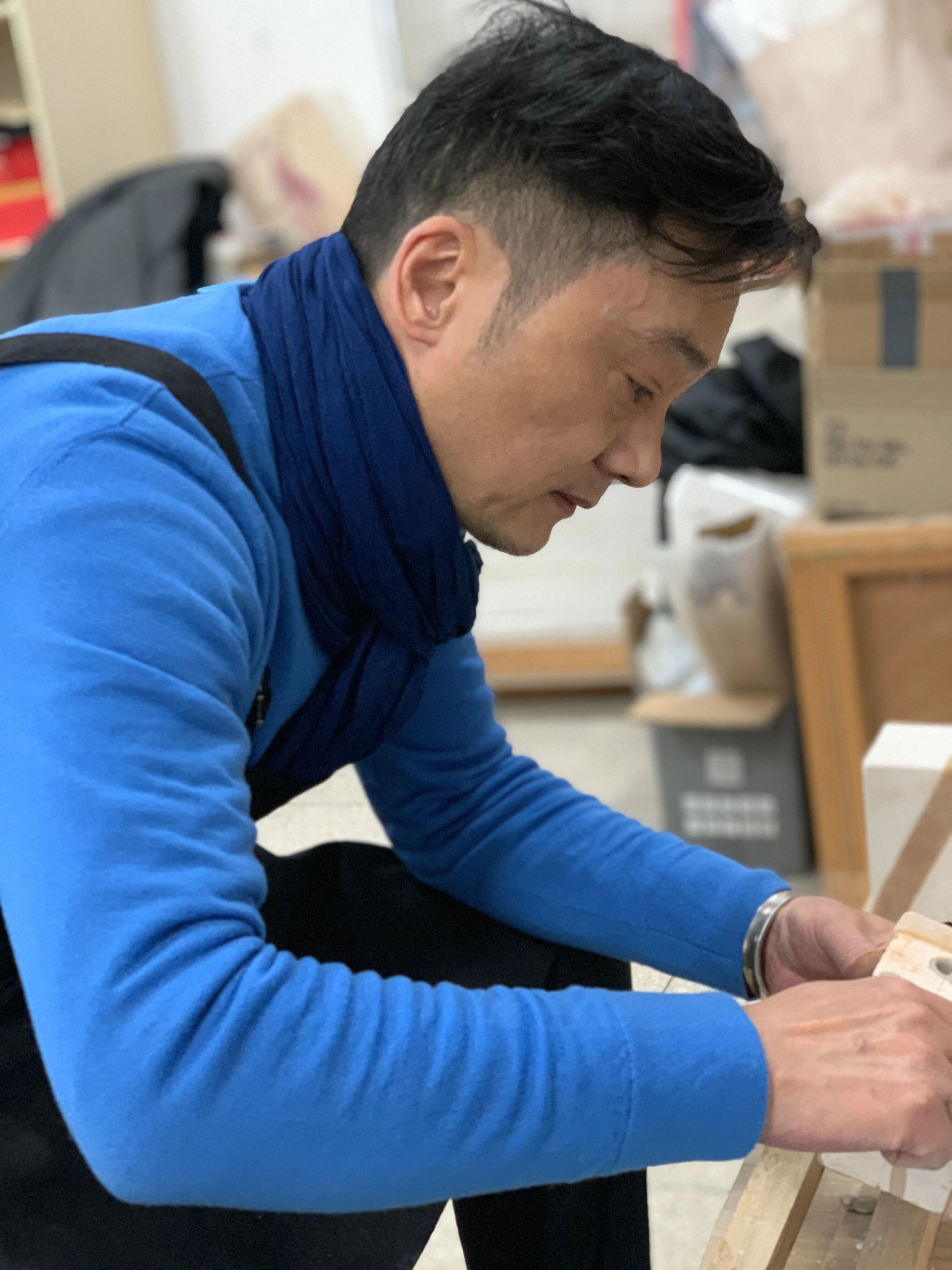
Chen Jun
Professor, Hubei Institute of Fine Arts
Master’s Supervisor
Associate Dean, School of Handicraft Art
Director, Jingdezhen Creation Center
Member, Ceramic Art Committee, China Artists Association
Member, International Academy of Ceramics(IAC)
Interview Notes:
Two keywords recur throughout Chen Jun’s thinking:“the site” and “ecology.”
The Jingdezhen Biennale is difficult to replicate precisely because it is rooted in a living, thousand-year-old ceramic “mega-site.” It is not merely the backdrop of an exhibition, but fertile ground where creation, production, education, and reflection are constantly unfolding. This deep sense of place gives the Biennale a unique confidence and warmth—artistic discourse here is not suspended in abstraction, but grows directly from the soil.
Looking ahead, Chen Jun’s expectations for the 2026 “dual-track linkage” also focus on building anecology. What he hopes to see is not only the brilliance of displayed works, but a sustainable network and cyclical system of dialogue woven together by exhibitions, conferences, education, and industry. This may well be the “invisible layer” that contemporary Chinese ceramic art must construct on its path toward maturity.
Q:Yu Lingna
A:Chen Jun
Q:As an alumnus of Jingdezhen Ceramic University, how do you view the advantages and uniqueness of the “Jingdezhen + JCU” model in hosting the Biennale?
A:From the perspective of a JCU alumnus, the combination of Jingdezhen and the University represents a highly recognizable cultural phenomenon on a global scale. Jingdezhen is not merely a geographical concept; it is a ceramic knowledge chain that has continued for over a thousand years—from raw materials and techniques to systems of labor division and aesthetic traditions. Jingdezhen Ceramic University is the modern educational and academic bearer that systematizes and transmits this body of knowledge.
This high degree of coupling among city, university, industry, and culture is rare in the global ceramic landscape. It allows the Biennale to function not just as a platform for displaying works, but as an academic event genuinely embedded in ceramic production sites, educational systems, and historical contexts. This complete ecology—from material origins to the circulation of ideas—is the most irreplicable advantage of the Jingdezhen Biennale.
Q:The Jingdezhen International Ceramic Art Biennale is not only an exhibition venue, but also resembles a multifaceted prism. It reflects how different civilizations, in a globalized context, interpret and attempt to reconcile the seemingly contradictory concepts of “the spirit of the vessel” and “contemporaneity.” From this perspective, how do you evaluate the Biennale?
A:In a globalized context, contemporary ceramic art constantly faces a key dilemma: on one hand, the spirit of the vessel carries history, corporeality, and functional traditions; on the other, contemporary art emphasizes conceptuality, criticality, and cross-media expression.
The value of the Jingdezhen Biennale lies precisely in the fact that it does not attempt to resolve or erase this contradiction. Instead, it allows artists from different cultural backgrounds to present their own interpretations of “contemporaneity” within a shared material context. Some advance concepts through craftsmanship, some reconstruct the meaning of objects through installation and spatial strategies, and others explore ceramics’ public attributes through social issues. This parallel coexistence makes the Biennale an important window for observing the global circulation of ceramic ideas.
Q:The 2026 Jingdezhen International Ceramic Art Biennale will take “The Future of Ceramics” as its theme and open concurrently with the 52nd IAC International Ceramic Congress, becoming a major global event. What kind of new dialogic space do you think this “dual-track linkage” will create for the international ceramic community?
A:The dual linkage of the Biennale and the 52nd IAC International Ceramic Congress will turn Jingdezhen into a highly concentrated and dynamic hub for global ceramic discourse. The Biennale leans toward works and practice, while the Congress focuses on theory, methodology, and international networks. When both unfold in the same city at the same time, artists, scholars, educators, and curators can engage in repeated dialogue within a shared context.
This setting helps break down the barriers between exhibitions, conferences, and education, allowing the future of ceramics not only to be displayed, but to be collectively discussed, negotiated, and shaped.
Q:Compared with long-established biennales such as Faenza in Italy and Mino in Japan, how should the relatively young Jingdezhen Biennale anchor its differentiated positioning and core competitiveness within the global ceramic discourse system?
A:Compared with mature biennales like Faenza and Mino, the youth of the Jingdezhen Biennale actually signifies openness and plasticity. Jingdezhen’s distinctiveness lies in the fact that it is not merely a site where exhibitions take place, but a living field where creation and production are continuously happening. I believe the Jingdezhen Biennale can further emphasize this state of “ongoing becoming,” positioning itself as a biennale that is research-oriented, experimental, and open, rather than simply benchmarking existing models.
Q:How do you view the role of a biennale in an artist’s growth trajectory? How can a balance be struck between “academic authority” and “youthful inclusiveness” to better serve as an international platform for nurturing new ceramic talent?
A:For artists, a biennale is both a threshold and a pathway. Academic authority provides standards of judgment and professional depth, while youthful inclusiveness determines whether the platform has a future. The key lies in whether the evaluation mechanism can recognize works that are “unfinished yet full of potential.” A truly mature international platform should be able not only to affirm highly accomplished works, but also to reserve space for young artists in exploratory phases. This mechanism itself reflects an academic responsibility toward the future.
Q:Some argue that high-quality international ceramic exhibitions function as “silent classrooms,” pushing ceramic education from studios and classrooms into more open public spaces. Based on your teaching experience at Hubei Institute of Fine Arts, how should the Biennale synergize with university ceramic education? How can its resources be used in curriculum design and creative guidance to cultivate students’ international vision and innovative capacity?
A:I strongly agree with this view. Since the ceramic program at Hubei Institute of Fine Arts was formally established in 2008, we have continuously practiced this idea. Beyond daily teaching, the Academy has long organized international professional exhibitions, academic competitions, and forums of various scales. By inviting important ceramic artists and professors from China and abroad for teaching, lectures, residencies, and exchanges, we strive to build an open, diverse, and internationally oriented learning platform for students.
In my view, the key to synergy between professional exhibitions and university education does not lie in whether students directly exhibit or visit exhibitions, but in whether these experiences can be transformed into methodological awareness and problem consciousness. The Biennale provides students with a clear and concrete international reference system, making them aware that contemporary ceramics is no longer concerned solely with technical completion or formal innovation, but with the complex interconnections among material concepts, spatial relationships, and cultural positions. If such experience can guide students to reflect on their own practice within a broader context, the Biennale will no longer be merely a stage-based event, but a driving force for the continual renewal of ceramic education.
Q:New forms—such as mixed-material installations and the integration of digital technologies with ceramics—are constantly expanding the boundaries of the field. What new challenges does this pose for contemporary ceramic education? How can we integrate cross-media approaches while remaining grounded in ceramic materiality and craft traditions, and thus cultivate talents suited to the times?
A:I believe ceramic education must first help students establish a deep understanding of ceramic materials and the logic of craft. This is an irreplaceable foundation. On this basis, cross-media methods and contemporary art thinking can be introduced, enabling students to view ceramics as an open language rather than a closed technical system, while still maintaining material awareness in interdisciplinary creation.
Q:As a peak event, a biennale is highly visible. In your view, on what “invisible levels” does the ecology of contemporary Chinese ceramic art still need to build sustainable cycles?
A:The Biennale is a peak event, but ecological construction relies more on long-term mechanisms: an independent and professional system of ceramic criticism; collection and institutional support aligned with contemporary art; interdisciplinary collaboration with fields such as technology, humanities, and sociology; and a virtuous cycle in which industry feeds back into creation and research. These underlying mechanisms determine whether the achievements of the Biennale can truly sediment into lasting cultural accumulation.
Q:What are your expectations for the 2026 Biennale and the IAC Congress held together?
A:I hope that through the 2026 Biennale and the Ceramic Congress, the world will see the contemporary face of Chinese ceramic art, and that Chinese ceramics will gain a clearer understanding of their position within the global system.
Q:Finally, could you share a few words with young ceramic artists from around the world who are participating in the Biennale, regarding your hopes and advice for their creative journeys?
A:I hope young ceramic artists can all establish long-term, sincere relationships with their materials, and maintain understanding of—and confidence in—their own cultural experiences amid a constantly changing world context. When you find a language of your own in clay, it will naturally connect with your time.
2026 “The Future of Ceramics” Jingdezhen International Ceramic Art Biennale